Deterministic Validation for AI, High-Consequence Automation and Enterprise Systems
ADRK is a deterministic validation system for organizations facing AI hallucination, model drift, unreliable automation, conflicting data, and unsafe downstream execution.
ADRK is not another AI model. It is a Deterministic state-realization architecture that decides whether candidate information can become approved realized state for automation, safety, compliance, monitoring, reporting, or action.
AI, Sensor, or System Input
Model output, camera feeds, telemetry, records, transactions, API events, or operational signals.
Domain Contract
Event definitions, state references, invariant conditions, constraints, and output boundaries.
DRK Enforcement
The kernel validates, rejects, blocks, or realizes candidate state under deterministic rules.
Approved Realized State
Only approved state becomes available for queries, alerts, automation, projection, or backend execution.
Probabilistic Output Cannot Be Treated as Authority
Large organizations are moving AI into workflows where mistakes are expensive: automation, electronics, industrial systems, compliance, cybersecurity, finance, safety monitoring, and backend operations. In those environments, a probable answer is not enough. The system must know what state is valid before action occurs.
The Enterprise Failure Mode
AI hallucination, model drift, low-confidence interpretation, incomplete telemetry, conflicting records, or noisy sensor data can become dangerous when downstream systems treat them as trusted state.
The problem is not that AI has no value. The problem is allowing uncertain output to directly trigger records, alerts, automation, approvals, or backend execution.
The ADRK Control Boundary
ADRK sits between uncertain input and enterprise action. It forces candidate information through deterministic validation before it becomes trusted system state.
- AI interpretation does not automatically become authority
- raw input must pass deterministic validation
- invariants and constraints are enforced by the DRK
- invalid transitions can be rejected before execution
- approved state becomes queryable, auditable, and reusable
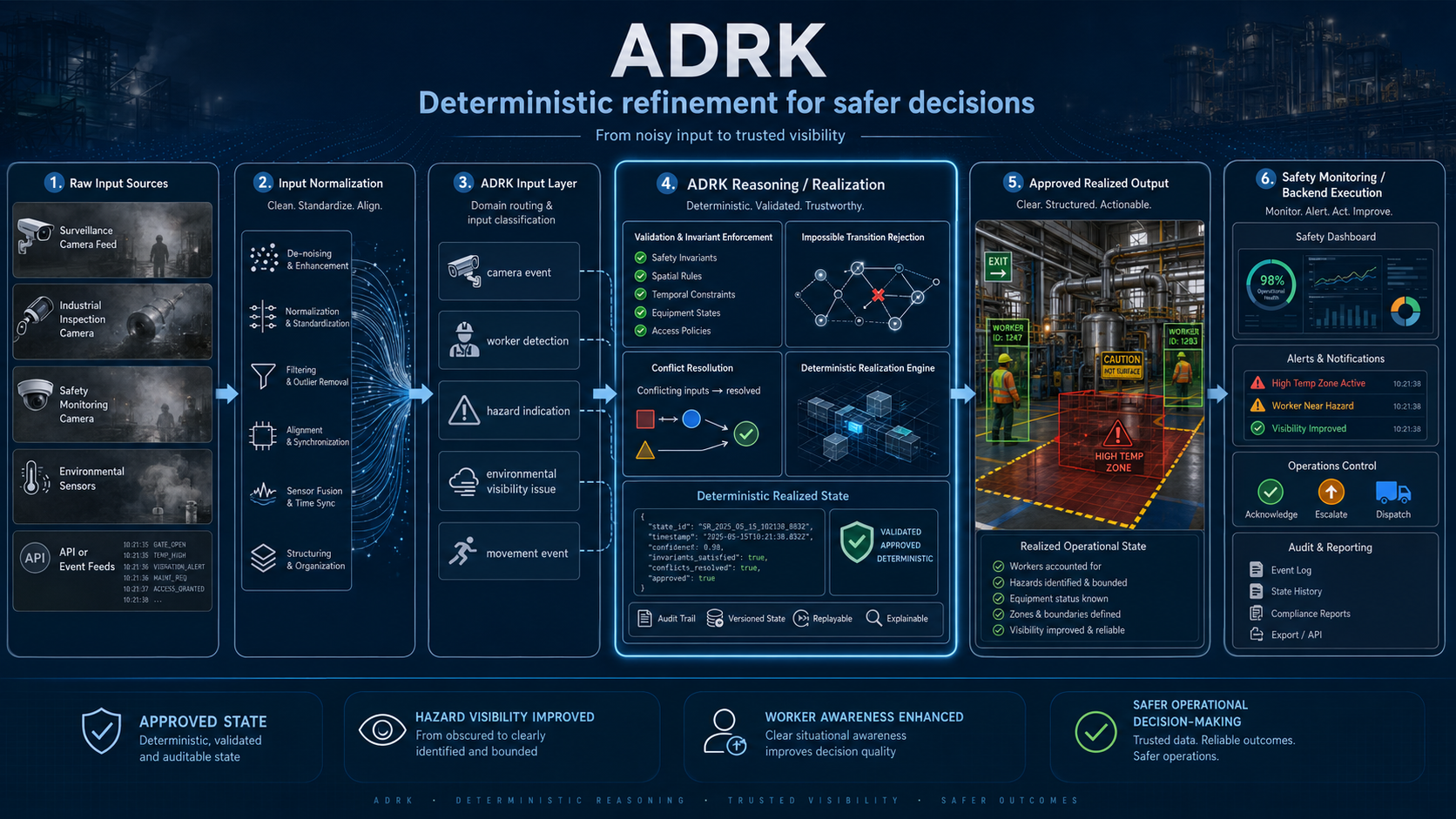
From Obstructed Camera Input to Approved Operational State
In hazardous worksites, raw visual input can be degraded by smoke, dust, glare, low light, dirty water mist, or environmental obstruction. ADRK can validate whether interpreted camera and sensor information is reliable enough to become safety-relevant state.
Core Message
Raw, unclear, or obstructed inputs do not directly become trusted state. ADRK routes structured input and supplied domain conditions into the DRK, where invariants and constraints are enforced before safety monitoring, alerts, automation, or backend execution can rely on the result.
Three Layers: Contract, Enforcement, Projection
ADRK separates domain meaning from deterministic authority. Domain contracts define what the workflow means. The DRK enforces whether candidate state is valid. OAFT can project from DRK-realized state without redefining current truth.
DRK Core
The Deterministic Reasoning Kernel is the enforcement and realization authority. It applies supplied invariants and constraints, rejects invalid transitions, realizes approved state, and exposes deterministic query access.
View DRK CoreDomain Contract Layer
Domain contracts define event schemas, state references, invariant conditions, constraints, rejection rules, and integration boundaries. They do not replace the DRK. They supply the conditions the DRK enforces.
View Domain Contract LayerOAFT Projection
OAFT extends DRK-realized state into controlled projections, reachability checks, threshold analysis, and future-state evaluation while preserving the deterministic state boundary.
View OAFTWhere Deterministic AI Validation Matters
ADRK is designed for enterprise environments where uncertain inputs must be validated before they affect decisions, records, alerts, compliance status, automation, or physical systems.
Industrial Vision
Validate camera and sensor interpretations before inspection, safety, or machine-control systems act.
Electronics and Automation
Control when event signals, device state, or automated outputs become trusted execution inputs.
Cybersecurity
Turn noisy telemetry into controlled state before response logic, blocking, or enforcement occurs.
Finance and Accounting
Support deterministic posting, reconciliation, period logic, invariant checks, and audit-bound reporting.
Compliance Systems
Prevent incomplete, invalid, or unauthorized records from becoming approved compliance state.
Backend Automation
Stop unstable, contradictory, or unapproved input from directly triggering backend execution.
Start With One Workflow Before Enterprise Expansion
ADRK is evaluated by selecting one real workflow, mapping its inputs and state rules, then testing whether DRK-enforced realization improves reliability before action.
Preliminary System Review
Determine whether ADRK is relevant to a specific enterprise workflow involving AI output, uncertain input, automation risk, compliance risk, or state-control failure.
- workflow and use-case review
- input and output boundary mapping
- risk review for hallucination, drift, or uncontrolled automation
- domain-fit assessment
- proof-of-concept recommendation
Proof-of-Concept Architecture
Demonstrate how one workflow becomes DRK-enforced realized state before downstream automation, reporting, alerting, or backend execution.
- single-workflow architecture map
- raw input source identification
- backend output path mapping
- event schema definition
- invariant and constraint model
- DRK enforcement boundary definition
- technical validation roadmap
Domain Contract Design
Map operational state, event types, invariant conditions, constraints, and integration boundaries into a contract the DRK can enforce.
- domain state reference definition
- event taxonomy design
- invariant and constraint condition modeling
- DRK enforcement contract planning
- query surface planning
- integration boundary definition
- OAFT export mapping, if applicable
Licensing and Enterprise Integration
Evaluate ADRK as a reusable deterministic validation layer for controlled enterprise deployment.
- licensing structure review
- deployment boundary planning
- integration responsibility mapping
- governance and access-control planning
- technical handoff documentation
- validation and acceptance criteria
Evaluate ADRK Against One High-Risk Workflow
The strongest starting point is one workflow where AI output, sensor input, records, telemetry, or automation signals cannot safely become trusted state without deterministic validation. ADRK can be reviewed at that boundary first, before wider enterprise adoption.